
The SSS Lux Journal | 4 Min Read
Most people choose a watch by its brand, its case or its price. Very few choose it by the small marks around the dial, yet those marks are the first thing anyone reads when they glance at your wrist across a table.
Hour markers, also called indices, do a simple job: they tell you the hour. But over time they have become a signature, a quiet statement of temperament. Here is how to read them, and how to choose the one that fits the way you work.
Roman Numerals: The Institution Builder
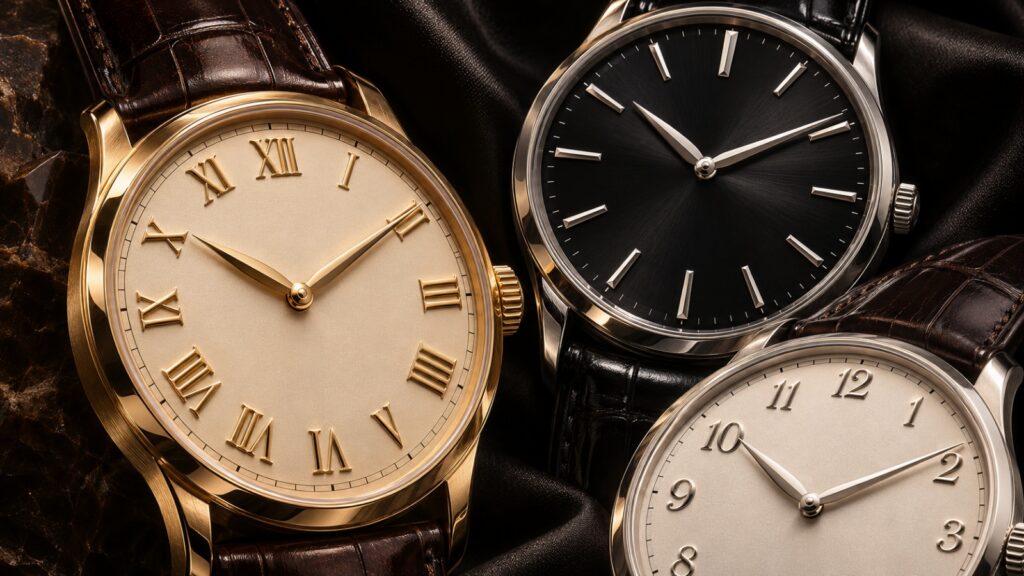
Roman numerals carry a sense of ceremony. They suggest lineage, tradition and permanence, which is why dress watches have favoured them for generations. Cartier is the house most closely associated with the style.
If you are building something meant to outlast you, such as a family business, a legacy brand or an institution, Roman numerals speak the same language.
They say: I am here for the long term.
Baton Markers: The Modern Operator
Baton markers, sometimes called stick indices, are slim, polished bars. They are clean, balanced and easy to read, and they appear on everything from slim dress watches to luxury sports models.
This is the dial of the founder who values clarity over decoration. Nothing is wasted. Decisions are made quickly and the room is read accurately.
Baton markers say: I respect your time.
Arabic Numerals: The Confident Communicator
Bold Arabic numerals are the most legible and the most outspoken. Pilot and field watches rely on them because they can be read in a second. Some famous watches keep only the 3, 6 and 9 and drop the rest, which is a confident edit.
If your work puts you in front of people, such as on stage, on camera or leading a team, Arabic numerals suit your energy.
They say: I have nothing to hide.
“A watch is the one piece of jewellery that is also an instrument.”
Dagger and Arrow Markers: The Person with a Point of View
Faceted dagger markers and sharp arrow indices have a mid-century flair. They are decorative without being fussy, and they catch the light well.
They suit the leader who likes craft and is comfortable being noticed for good taste.
No Markers at All: The Minimalist
Some dials remove the hour markers entirely, leaving only the hands and the face. It is the most understated choice and the most demanding one.
It suits someone who no longer needs to explain anything.
Precious Details: Applied Versus Printed
Two finishing details matter just as much as the shape:
Applied Markers: These are separate pieces fixed onto the dial. They add depth and catch reflections, which gives the dial a sense of luxury.
Printed Markers: These are flat. They feel clean and vintage, and they are common on military, dive and heritage-inspired watches.
Some watches go further, setting diamonds or other gemstones at the hours. That is a different message again: celebration rather than restraint.
A Simple Way to Choose
Before you buy, ask yourself three questions:
1. Where will I wear it most?
Boardrooms favour batons and Romans; stages and travel favour Arabic numerals.
2. What do I want the watch to say before I speak?
Permanence, precision or confidence?
3. Will it still feel right in ten years?
Classic shapes age best.
A watch is the one piece of jewellery that is also an instrument. Choose it as you would choose an advisor: for how it makes you perform, not only how it looks.
Continue the Conversation
Thinking about your first serious watch, or your next one?
Request a conversation with SSS Lux Advisory.